
What is the Global Gateway Africa-Europe Investment Package?
Adam Garba
Accra, Ghana
November 03, 2025
T he second edition of the Global Gateway Forum took place in Brussels on 9-10th October 2025. The Forum brought together representatives from governments, financial institutions, the private sector, and civil society. On this occasion, participants explored innovative strategies for scaling up the Global Gateway investments in partner countries. The EU says that the Global Gateway is a response to emerging geopolitical and geo-economic challenges brought by China and the US tariff war. Ursula von der Leyen (President of the EU Commission) described the Global Gateway as the ‟EU’s contribution to the Sustainable Development Goals beyond its borders”. She explained that this new policy will build ‟smart, clean, and secure connections in the digital, energy, and transport sectors, as well as strengthen health, education, and research systems globally”. The EU says it has raised €300 billion for the program and that it plans to invest around €150 billion in Africa between 2021 and 2027. How will the program work, and how does this new policy differ from previous ones?
Falling Cocoa production
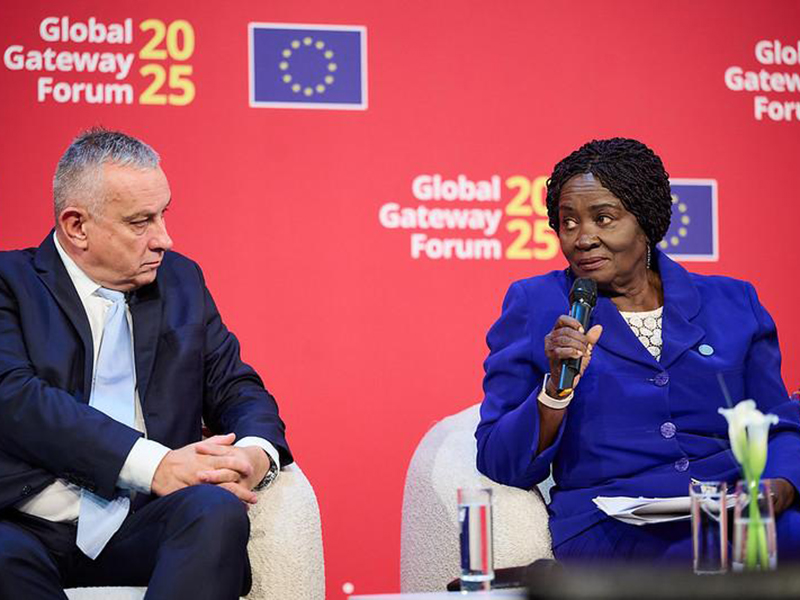
Source: Photo credit: Ghana Embassy, Brussels
Global Gateway in practice
The Global Gateway is a direct descendant of previous policies. It extends the European Partnership Agreements (EPAs); a trade agreement with over 70 countries and regions. The European Partnership Agreements (EPAs) themselves grew from the Cotonou Agreement, which replaced a unilateral trade preferences system for African, Caribbean, and Pacific (ACP) states. However, while the EPA focused on trade, the GG concentrates on projects and investments. On October 09th, 2025, the policy had 12 flagship projects, two of which have economic implications for Ghana. They are the ‟Ghana EU Sustainable Cocoa Initiative” and the ‟Powering renewable energy in Africa”. To implement the new policy, the EU is signing cooperation agreements with multilateral banks, for example, the World Bank, the European Investment Bank (EIB) and the African Development Bank. Specifically, the European Commission and the African Development Bank have signed a new framework agreement through which, the EU plans to boost the Global Gateway infrastructure initiative in Africa.
The EU has set up a Global Gateway Investment Hub to serve as an an entry point for European companies. Grants, concessional loans and guarantees will contribute to risk-sharing and make projects viable for funding.
Ghana: Joint Programming Global Gateway Priorities
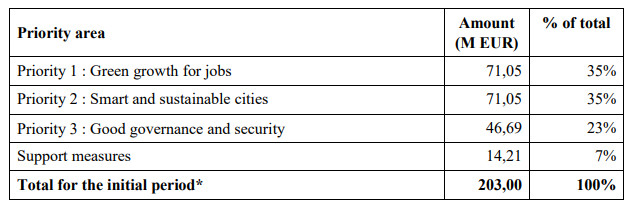
Source: Joint Programming for 2021-2027, EU
Projects
In 2024, the Global Gateway projects database listed 138 projects worldwide, in five areas: digitalization, climate, and energy, transport, health, and education and research. The EU says it has allocated half of these projects to Africa and expect financial returns form the loans it will provide. Through these projects, the EU wants to promote innovation, good governance and sound business climate.
In Africa, the EU has pledged to harness Africa’s economic potential through strategic and innovative investments. This entails efforts to improve the business climate by strengthening institutions, ensuring legal certainty, and also by building skills and infrastructure.
In this context, the EU has announced that it will anchor the Global Gateway to existing programs. The first program is the EPA, which the EU is expanding to cover services and intellectual property. The second is the ‟Clean Energy Transition”. Here, the EU is using instruments such as the ‟Clean Trade and Investment Partnerships and Sustainable Investment Facilitation Agreements” to support this collective effort. Thirdly, the Horizon Europe ‟Africa Initiative III”program, with a budget of €500 million, aims to boost cooperation in research and innovation between Africa and Europe. Finally, the EU has committed to an alignment of its programs with the goals of African Continental Free Trade Area (AfCFTA), and focus on areas of mutual interest like job creation and industrialization.
Ghana and the Global Gateway
Ghana has expressed an interest in the Global Gateway program. Vice President Naana Jane Opoku-Agyemang signaled this interest with her participation in the 2025 Global Gateway Forum, during which she called for EU investment in Ghana. Ghana’s major goal in this partnership is to improve its competitiveness and transform the domestic industrial value chain across its 16 active economic sectors.
Prior to the Global Gateway, in April 2022, Ghana signed a ‟Joint Programming for 2021-2027”1 agreement with the EU. Under this program, the EU committed EUR 203 million for the period 2021-2024 for growth, climate issues, and governance.
Since inception, the Global Gateway has become an anchor for components of the ‟Joint Programming for 2021-2027”. It brings together the European Green Deal on climate change, the EU Gender Action Plan and the EU Youth Strategy, which seeks to foster youth participation in democratic life. The EU remains an important export destination and import for Ghana, accounting for 13.9 percent of Ghana’s total external trade in 20222.
Related Articles
BIBLIOGRAPHY
1❩ https://oec.world/en/profile/bilateral-country/gha/partner/mar
1❩ https://brussels.mfa.gov.gh/ghana%E2%80%99s-vice-president-participates-in-the-global-gateway-forum#:~:text=Jane%20Naana%20Opoku%2DAgyemang%2C%20Vice%20President%20of%20the,year's%20Global%20Gateway%20Forum%20held%20from%209